



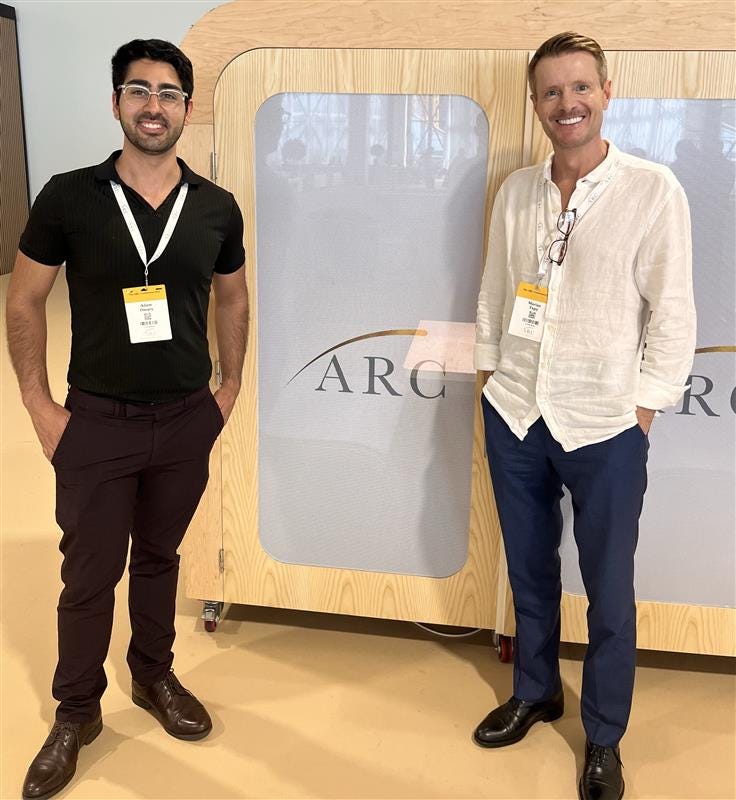
Last week I had the honor of attending, for the second time, the Alliance for Responsible Citizenship (ARC) Conference in London. I joined over 4,000 other attendees, and speakers including prominent academics, entrepreneurs, and political leaders motivated by a shared optimistic vision for the future.
Outside the venue, a cluster of protestors had assembled ostensibly opposed to our perspectives on energy and technological progress. It was, fittingly, the middle of a record heatwave. It has been the warmest June on record for England with temperatures above 35 degrees Celsius (95 Fahrenheit). And the country was singularly ill-equipped to cool itself. Only about five percent of British homes have air conditioning, against nearly ninety percent of American homes.
While the last two centuries of industrial progress have indeed contributed to global warming, its impact is minor. That was the argument of speaker Bjorn Lomborg, rational environmentalist and champion of human progress, whose perspective on climate was recently vindicated by Bill Gates. He argues that cheap, plentiful energy is the single most powerful anti-poverty instrument humanity has ever devised, more transformative for the dispossessed than any wealth transfer program, because it is the substrate on which food, water, medicine, sanitation, transport, and education all run.
Also speaking at the conference was physicist Steve Koonin, arguing that warming is real but manageable and comparatively minor, and that the loudest doom forecasts rest on implausible assumptions and unreliable models. In fact, extreme cold kills far more people than extreme heat at a ratio of nearly nine to one.
There is a stubborn intuition in modern culture, one that ARC is largely protesting against, that consumption is sin and that the moral response to a warming planet is to use less.
Air conditioning is a useful test case, because it is treated in Britain as a guilty indulgence rather than the life-saving technology it is. An innovation that keeps people alive and lets them think clearly year-round is not an extravagance to be rationed. It may well pay for itself, not only in lives but in the compounded output of minds that are not, for weeks at a time, too hot to work. As economist Julian Simon famously argued, human intelligence is the ultimate resource. Energy is nearly unlimited throughout the universe, but only intelligence can turn matter into useful work.
Nearly everyone at the conference wants more clean energy, including speaker and U.S. Energy Secretary Chris Wright. The disagreement with the protestors outside is about the route more so than the destination.
In the nineteenth century, whale oil was a prized commodity for its use as a long-lasting fuel for lantern lighting, and whales were being hunted nearly to extinction. We did not save them by resolving collectively to hunt fewer whales and rationing oil, though that is exactly what environmentalists at the time advocated for. Whaling declined because kerosene, petroleum, and eventually the electric light made whale oil obsolete. Degrowth would have kept us hunting whales, only more guiltily and less efficiently. The way off fossil fuels is not to burn less and suffer more; it is to innovate until the cleaner option is also the cheaper and better one, at which point the transition takes care of itself, as it always has.
This is why the panic over artificial intelligence’s energy appetite strikes me as exactly backward. The data centers needed are indeed power hungry, and their consumption is real and rising. But the wager worth making is that going all-in in the short term is the surest path to clean and sustainable energy in the long term. The same systems now straining the grid are accelerating the materials science, nuclear fusion and fission research, and the grid optimization on which any durable transition depends. To throttle the technology now, in the name of the emissions it currently produces, is to insist on hunting whales forever rather than inventing the light bulb.
Not all of the conference was so techno-optimist. Technology, several speakers observed, is a magnifier, a Cambrian explosion that accelerates either abundance or dissolution depending on the values that steer it. That framing invites a question no engineer can answer: toward what end? It was on this terrain, the terrain of meaning, that the conference’s genuine philosophical divide came into view, and it is also where ARC’s religious conservative base parts company with the classically liberal tradition I inhabit.
Harvard professor Arthur Brooks gave the fullest statement of the worry, describing what he called a crisis of meaning and a corresponding science of happiness. He spoke of a psychogenic epidemic, that twenty to thirty percent of young men and women reporting that their lives lack meaning. His diagnosis located the cause not in any material want but in mind and culture alone, and he reached for Iain McGilchrist’s pseudoscientific theory, closer to phrenology than contemporary neuroscience, that a civilization can become dangerously dominated by its analytic left hemisphere at the expense of its creative right. The prescription, across many of the talks, was communal and often explicitly religious.
The tendency toward manufactured crisis was clearest on the subject I know best. The actor and campaigner Sophie Winkleman delivered a forceful case against childhood screens, against educational technology, and against the obscenity of the modern internet, arguing that screen-raised children lose the capacity for imagination and play and that the physical embodiment of words on a printed page is measurably better for the developing brain. Her argument was moral panic dressed in the borrowed authority of developmental science. The identical alarm was raised about the printing press, the novel, radio, and television, each in turn, and each time the predicted catastrophe failed to arrive.
As I’ve written, the largest synthesis of the evidence on screens and mental health finds that effects are small, inconsistent, and confounded by other social-environmental factors. To the extent that screens are associated with decreased attention span, these are offset by other cognitive gains in multitasking and fast-information processing. To the extent social media use is associated with negative mental health, it is often because kids who are already depressed and lonely seek out connection online, or because the internet has improved mental health awareness.
One does not establish a claim by assembling the studies that flatter it and omitting the rest. I would not do it in the other direction and pretend that technology is always beneficial, because everything is a matter of tradeoffs.
My friend and ARC speaker Rob Henderson coined the concept of luxury beliefs: ideas that confer status on the affluent while inflicting costs on those without their advantages. The irony is that ARC harbors luxury beliefs of its own. To insist that every child be raised screen-free, on pencil and paper, is easy for parents who can afford small classes, private tutors, and homes full of books. It is a far costlier prescription for the poor child whose cheapest path to a decent education may be a tablet and a capable AI tutor. A belief that costs its holder nothing while imposing real costs on the disadvantaged is a luxury belief whether it issues from the progressive left or the reconstructionist right.
That is where I profoundly disagree with some of the policy prescriptions put forth at ARC, including social media bans and attempts to regulate “obscene” content under the guise of protecting minors. As I and my colleagues have written, these regulations do not work, and they undermine privacy and freedom for adults.
I say this all as a friendly critic. ARC is, at heart, a religious and communitarian project, and its instinct when it perceives a spiritual vacuum is to fill it. My concern is that some of their crises are manufactured self-fulfilling prophecies. To call a widespread human experience a psychogenic epidemic is to perform, at civilizational scale, the same concept creep that has driven psychiatric overdiagnosis in the clinic, where ordinary struggle is steadily reclassified as pathology.
Take the crisis of meaning. I do not believe that it is found in rising rates of depression and anxiety, because the diagnostic criteria themselves have continued to widen, even while suicide rates are decreasing worldwide. But, the crisis of meaning is real insofar as many, many people believe it is real, and I speculate that may in part explain the worldwide fertility crisis. Having a child is the most meaningful optimistic bet on the future one can make, and increasingly young people are not taking that bet. This is even as speakers and prominent commentators on fatherhood and masculinity Nick Freitas and John Papola, not to mention the founder of ARC who was tragically absent due to illness, Jordan Peterson, have all argued: responsibility is the key to meaning, and parenting is one of the surest ways to responsibility.
Konstantin Kisin argued that when he said that liberty and responsibility are mutually dependent. Moral compulsion is not virtue. A citizen coerced into the right behavior has demonstrated nothing about his character. Meaning is found in freely chosen problems worth solving, in voluntary attachments and self-directed sacrifice, and the moment a community or a government undertakes to prescribe it, the thing it produces is conformity rather than purpose.
I have argued before that the so-called crisis of meaning is better understood as a byproduct of progress than as evidence against it. Our attention evolved to track threats and losses more closely than gains, and in an environment saturated with the visible troubles of the entire planet, that negativity bias produces a mood far grimmer than the underlying facts warrant. To feel unmoored amid an abundance our ancestors could not have imagined is not a disease. It is the predictable psychology of people who have won a birth lottery they did not earn and have not yet decided what to do with it.
What we most need to defend is not any particular tradition but the classically liberal framework that lets traditions compete, persuade, and renew themselves without compulsion. That framework prioritizes liberty above all, not only the positive rights we are owed but the negative liberty to be left alone, to be wrong, and to arrive at meaning by our own path rather than one assigned to us. Freedom is not one value among many. It is the precondition for the others, because progress, virtue, and meaning are worth little when they are coerced. A society that legislates its answers to the deepest human questions will harvest compliance where it hoped for conviction.
ARC takes its name from the Biblical Noah’s Ark, and from the conviction that history turns on the actions of a committed few. A small number of responsible people, willing to build when everyone else is content to complain, can bend the course of a civilization. ARC is itself evidence for the claim.
From courageous feminists such as speaker Sall Grover and my friend Helen Joyce, to my colleagues at the Open Therapy Institute, which aims to combat bias within the mental health care field, the small but mighty numbers at ARC are making a difference in culture and policy.
My favorite talk of the conference by far was the NASA astronaut Victor Glover, who months earlier had piloted Artemis II, humanity’s first crewed voyage around the Moon in more than half a century. Glover spoke about the awesome psychology of awe, and about looking back at Earth to see not nations but a single fragile oasis, a spaceship we all crew together.
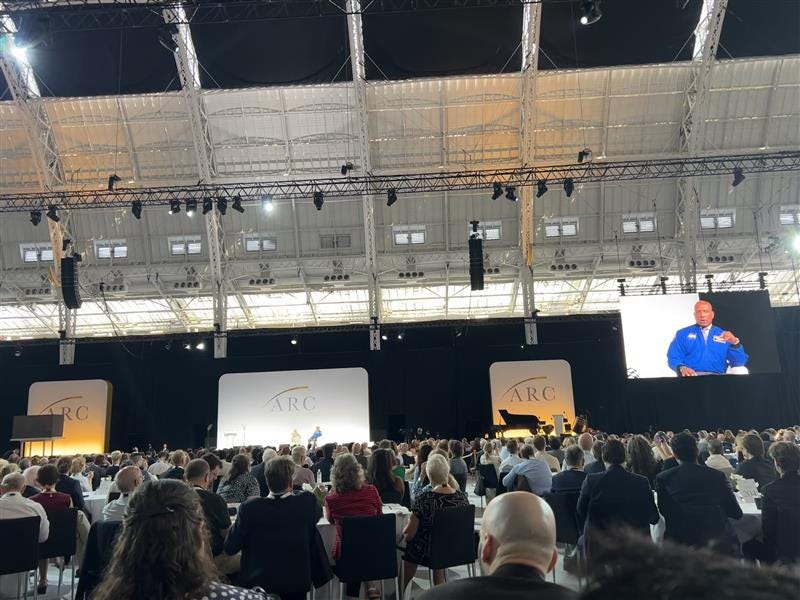
If having a child is the most optimistic bet on the future an individual can make, then leaving our home planet to one day colonize the galaxy is the most optimistic bet a species can make.
To place that bet, individually and as a species, is itself an answer to the question ARC keeps asking. To be a responsible citizen is not to obey a prescribed set of virtues, nor to ration one’s life against catastrophes that never arrive. It is to build when others only complain, to choose one’s attachments and sacrifices freely, and to wager on the future rather than against it. The vessel worth building carries freedom as its cargo, because the surest way to save a civilization is not to compel its virtues but to protect the liberty in which virtue, meaning, and progress can be freely chosen. Responsible citizenship is agency over fear.