


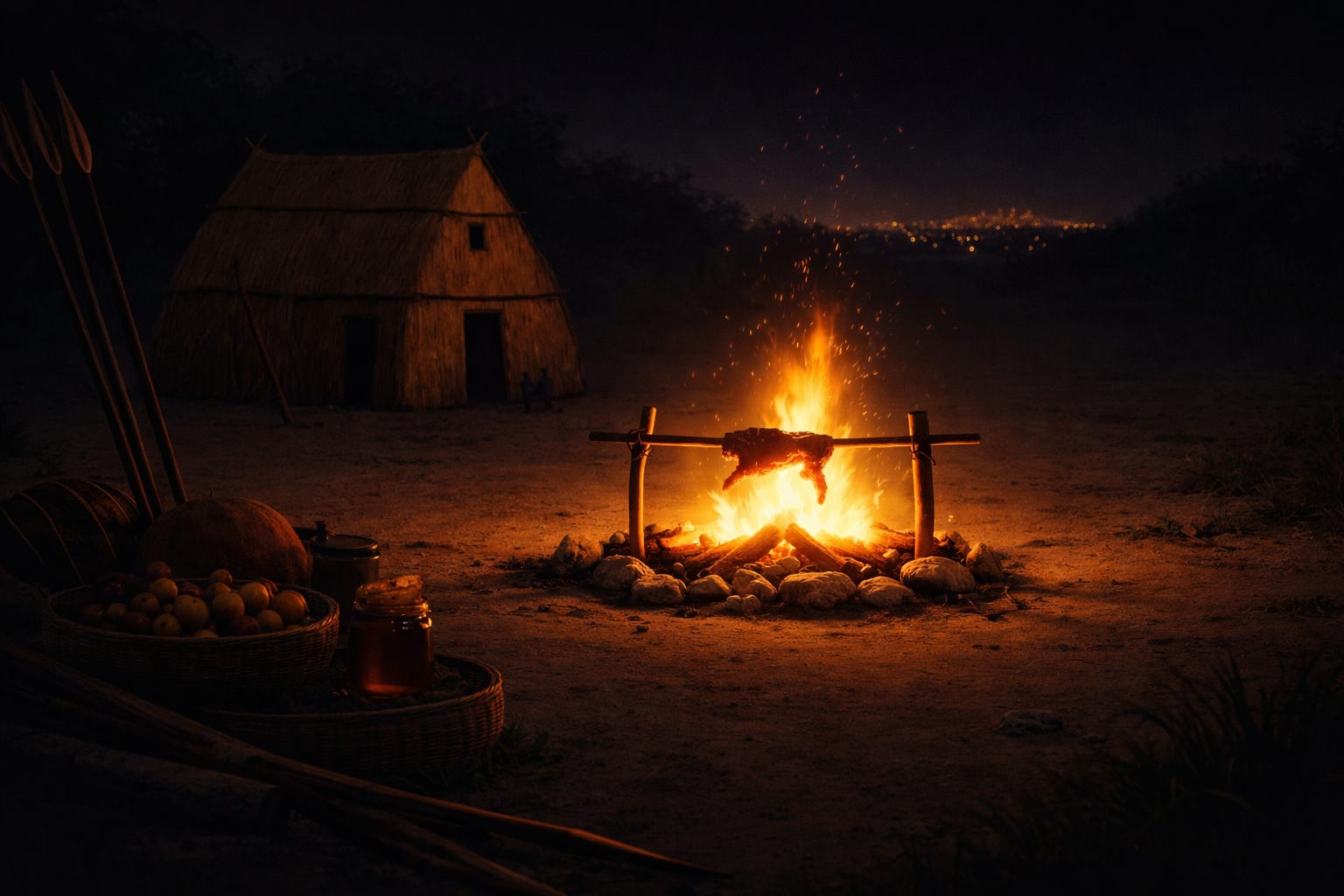
What’s the most important thing in life? “Meat and honey,” the chieftain of the Hadzabe—one of humanity’s last living tribes of hunter-gatherers—answers. “If we have meat, honey, and water,” a young hunter adds, “then we are happy.”
Today’s world is unrecognizable by historical standards. It is difficult to appreciate the value of food and water when a whole cooked rotisserie chicken and a jar of honey cost less than an hour’s minimum wage, and clean water can be freely accessed in almost any public place. For our hunter-gatherer ancestors—and the Hadzabe today—every meal required miles of trekking, dangerous hunts, and no guarantee that everyone would return for supper. Most water carried parasites. People lived in mud huts crawling with bugs. Life expectancy was brutally short, largely driven by high infant mortality, lack of vaccines, and lack of antibiotics. Infection from even a small wound could mean death.
Life was better, but not much better, for our agriculturalist ancestors. Widespread famines occurred in Europe within the last two centuries. Life expectancy was hardly better than that of hunter-gatherers, and medicine often did more harm than good. (George Washington’s death was hastened by the then-common practice of bloodletting—over 40% of his total blood volume was drained, to supposedly drain out an infection that might have otherwise been survivable, and almost certainly would be survivable today with modern antibiotics.) For those fortunate enough to stay healthy, survival still involved hard physical labor each day to earn their food.
One hundred years ago, only about 25% of Americans worked as farmers—down from over 70% a century earlier, despite a tenfold population increase—thanks to massively increased agricultural production after the Industrial Revolution. Electric lighting and indoor plumbing were beginning to become commonplace, and much progress was made towards eradicating smallpox. However, polio and other diseases still ravaged, antibiotics were not yet invented, and basic chores such as washing clothes still required hours of manual labor. Even in the most prosperous society in the world, meat and sugar had to be rationed during World War II—within living memory of the oldest Americans alive today.
In the decades since then, life has become safer and more abundant than ever. Agricultural production today is at an all time high, despite fewer than 2% of Americans working as farmers. Child mortality is lower than ever. We have more free time thanks to time-saving appliances such as dishwashers and laundry machines. Public services are more widespread than ever and civil liberties finally live up to our founding ideals of life, liberty, and the pursuit of happiness. Not to mention the technological miracles that have given our species powers once found only in mythology. We have flying chariots, despite the hassles of airport security and cramped leg room. We have crystal balls in our pockets that can FaceTime loved ones on the other side of the world and access nearly all of humanity’s knowledge in an instant.
Modern life is miraculous.
Why, then, are we supposedly in the midst of a mental health crisis?
For one, let us look at the problem with healthy skepticism and cautious optimism. It’s true, diagnoses and self-reports of depression and anxiety are higher than ever, particularly in young people. However, one possible interpretation of these data is that what’s changing is mental health monitoring, rather than mental health itself. Psychiatry as a field is hardly more than a century old, and it was heavily stigmatized and less than scientific throughout most of its history. Perhaps what we now call mental health problems are what our ancestors called the inevitable vicissitudes of life.
Analogously, a surface-level read of cancer statistics suggests that more people are being diagnosed with and dying of cancer than ever before. That is true, with two important caveats. First, cancer screening is earlier and more sophisticated than ever, leading to more overall diagnoses but also overall better outcomes. Second, mortality rates from almost all other causes are lower than ever and people are living longer than ever. Cancer risk increases with age, so in a morbid paradox higher cancer rates are a sign of a healthy society. Hunter-gatherers have lower rates of cancer not because they are healthier, but because they rarely live long enough to see it develop, much less properly screened and diagnosed.
Could it be that rising rates of depression and anxiety are a paradoxical sign of health? When toiling for daily survival, there is little room for psychoanalysis. Perhaps only in a world of material abundance, safety, and comfort—where mood swings and family or relationship conflict represent life’s biggest challenges for otherwise healthy people—do we begin to contend with the possibility that such adversity is not inevitable but a problem to be solved.
That is not to be dismissive of the problem at hand. Suicide rates are rising as well, at least in the United States, which points to a deeper crisis. A crisis of meaning.
Our brains evolved for survival. There are little drives stronger than hunger. True hunger, which most Westerners have never experienced. Of those living in wealthy democracies who have ever gone several days without food, it was in all likelihood a voluntary fast or a byproduct of serious illness. But most of us can imagine the rewards of rest after an exhausting day, the savor of a delicious meal that took hours of preparation. They are intrinsically meaningful.
Increasingly, we do not have to exhaust ourselves to fulfill drives meant for survival and reproduction. Food delivery, entertainment, sexual gratification are all available at the click of a button. As time prices—the amount of hours worked necessary to buy goods or services—continue to lower, we have more free time than ever. With that freedom comes opportunity, but many find that freedom disorienting. Now that survival is easy, purpose is optional.
To make matters worse, our survival-evolved brains are not just unadjusted to our modern environment, but exploited by it. It was adaptive for our ancestors to indulge in fat and sugar whenever available, and to limit physical activity in the moments survival did not call for it. There was no question that calories would not be burned off later. It was adaptive for our ancestors to compare themselves to their community. There was no possibility that, in an age of global connectedness, unhealthy comparison to supernormal stimuli of digitally-enhanced beauty would make one feel inferior. It was adaptive to be attuned to problems in one’s environment, when one’s environment was local. There was no possibility of doomscrolling in captivated witness of every breaking catastrophe across the globe.
Thanks to the information age, we are paradoxically surrounded by evidence of humanity’s shortcomings while simultaneously more insulated from them than ever before. No wonder we are in an age of anxiety and moral confusion. After all, can we really afford to boast about human progress when so many global problems—war, poverty, pollution, terrorism—are more visible than ever before?
Fortunately, the solution lies in the critique of human progress itself. To doubt the viability of progress is to long for it.
Many people living in the most prosperous societies in human history are simply unaware of the scale and speed of human progress, through no fault of their own. Incremental progress is (sadly) boring and easy to take for granted. Problems demand attention. It is not surprising that our news has a negativity bias reflective of our psychology, and it would be naively optimistic to expect the incentive structure of the media landscape to change.
Yet self-awareness of our negativity bias may go a long way in reprioritizing our attention.
It is adaptive to pay more attention to what is going wrong than what is going right, but it is adaptive only when focused, constructive criticism motivates problem solving—a process which itself is inherently meaningful. When one’s environment is the crystal ball which can see in realtime every crisis unfolding in every corner of the world, the mental health forecasts are grim.
This is not to say that we ought to put the blinders on and bask in the good news. Even if we could, we would quickly find ourselves devoid of meaning, and progress would stall. Still, to feel disoriented or dissatisfied in this moment may itself be a symptom of progress. The so-called crisis of meaning is partially a byproduct of being born into a level of safety, comfort, and abundance that our psyches were not built to process. Unlike the vast majority of our ancestors—and unlike millions alive today still living under poverty and oppression—those of us in prosperous, liberal democracies have won a birth lottery we did not earn.
As much as that inspires gratitude, it may also evoke guilt.
I suspect that much of the doomsaying in the West today—whether about climate, artificial intelligence, or other catastrophes—including critiques of the very concept of human progress, is a flawed attempt to contend with this guilt. As if an intuition that things cannot be this good, we are too far outside the norm of human existence, things must be unstable and primed for collapse. Such existential dread beats apathy—at least in the pursuit of meaning, and in tacitly acknowledging that we have something worth protecting—but is unlikely to produce true progress.
What is? Acknowledging the real constraints of human nature, and working with them rather than against them. We have an innate propensity for rewarding challenges, alleviating suffering, ingenuity, but also an evolved negativity bias and propensity for social comparison that is maladaptive in a globally connected world.
Improper comparison—to a hypothetical utopia, or to the global bourgeoisie, as if a fixed caste rather than ever-changing extreme outliers of material abundance and social capital—leads to perpetual disappointment and the destruction of progress, if the catastrophic history of socialist experiments throughout the last century serves as any reminder.
But comparison need not always be the thief of joy.
A more humble and empirically grounded account of human history may instead inspire. Simply encountering this article means you, in all likelihood, live a higher quality of life than most humans who ever lived, with technology and abundance they could have never dreamed of.
Gratitude, properly understood, does not demand guilt—it demands responsibility. To be born into this era of superabundance comes at the cost of an inherently meaningful struggle for survival. But it offers the opportunity to choose problems worth solving. Humanity still has much room to progress, and we can say this without denying the miraculous work that has already been done.
what an amazing article. thank you