


Last month I had the privilege of attending the Alliance for Responsible Citizenship (ARC) conference in London, where I joined over 4,000 other attendees motivated in formulating an optimistic vision for the future.
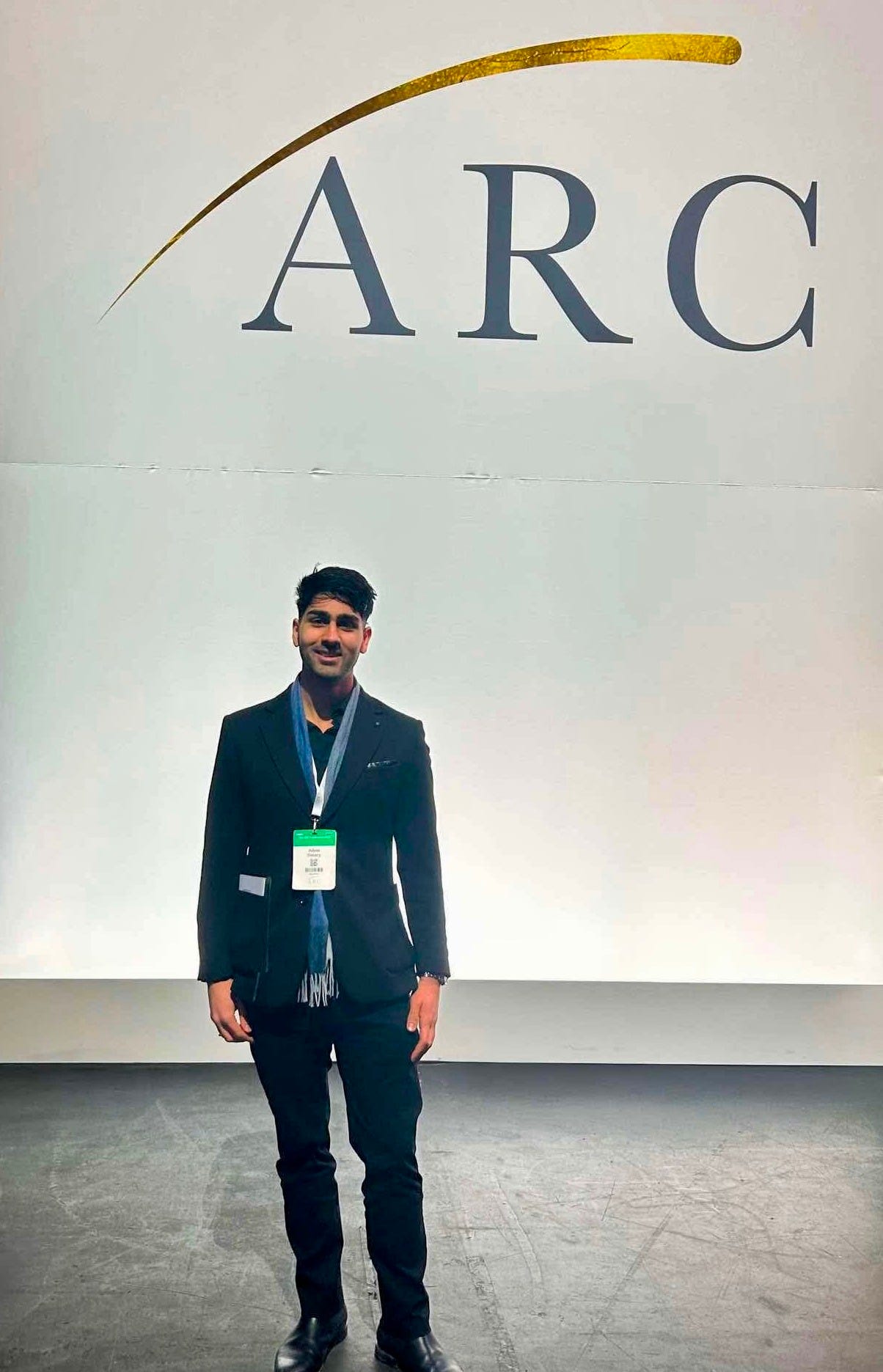
ARC alludes to Noah’s Ark, and the belief that the ripple effects of the actions of a minority of faithful, responsible citizens, can keep catastrophe at bay. As the story goes, the sinful descendants of Cain flood the world with evil to such a degree that even God views them as beyond redemption. Yet often overlooked in the drawn out genealogy of Genesis 4-5 is that after Abel is slain, Adam and Eve have a third son, Seth, his moral replacement. Noah is a descendent of Seth, not Cain, symbolically illustrating the direct transmission of the moral consequences of our actions. The murderous path of Cain produces Tubal-Cain, the maker of war, whose descendants set the stage for the flood. Conversely, the righteous line of Seth produces Noah, who saves life from extinction and is symbolically the direct ancestor of the moral line that ultimately produces Christ.
The philosophy behind ARC is that no problem that befalls us – be it the perils of war, natural disaster, authoritarianism, or nihilism – is beyond our capacity to resolve. With the proper moral orientation, commitment to the truth, and voluntary self-sacrifice, ARC posits that we can progress towards a world of greater peace and abundance. It also recognizes that, for all of our flaws and the very real existential threats we face, our species has already progressed tremendously in the right direction, and we must not lose sight of that morale.
As Steven Pinker writes in Enlightenment Now, whose themes and statistics overlapped with many of those presented at ARC, the world is better than ever before by almost every conceivable metric. Life expectancy is higher than ever, as is material abundance, education rates, and free time. Basic amenities such as electricity, refrigeration, plumbing, and antibiotics afford us with luxuries that even kings throughout history could never attain. Conversely, child mortality, disease rates, and violence are lower than ever before. Pinker credits these markers of progress directly to the Enlightenment philosophy of science, reason, and humanism.
Douglas Murray’s speech at ARC built on these themes and argues that Enlightenment values are the crowning achievement of Western civilization, not something to be taken for granted. He recounts as a child assuming that vanilla was the “default” flavor of ice cream, only later realizing that vanilla is itself a rich complex flavor added to ice cream, and an expensive spice considered as a luxury throughout much of history. Western civilization is vanilla, he states, to laughter and applause. Many Westerners may feel, or even argue, that they have no unique flavor. In the age of postmodern deconstruction, excessive focus has gone towards highlighting the flaws of Western civilization, and its experiences with colonialism, slavery, racism, and sexism. These problems have plagued every civilization throughout history, and in the words of Thomas Hobbes, the default state of human nature is “solitary, poor, nasty, brutish, and short.”
Yet ironically, the culture in which these problems are criticized the most is the one in which we have made the most progress – and to give credit where credit is due, largely because of the centuries of hard-won criticism that led to the abolition of slavery and culminated in the civil rights victories of recent decades. As Konstantin Kisin argued, where and during what time in history would an ethnic or gender minority be best living? The answer is now – or perhaps even a decade or two ago, before “progressive” deconstructionism had sufficiently polarized and demoralized us.
As social psychologist Rob Henderson spoke about, these criticisms are luxury beliefs: virtue-signaling ideas which confer status upon elites while inflicting costs on the poor. What are those costs? The erosion of meritocratic ideals, traditional family structure, and patriotism that motivate people to work hard and contribute to their society. Elites virtue-signal by pushing policies that harm those without their safety nets. They call to defund police while living in gated communities, glamorize single parenthood while relying on private daycare and nannies, and denounce patriotism while thriving in the nations they critique. As it is said, when the upper class catches a cold, the working class dies of pneumonia.
Douglas Murray’s solution to the problem of deconstruction is reconstruction: claiming ownership over the merits of Western culture. It is not the case, as progressive idealists argue, that the virtues of democratic humanism are universal ideals. They are uniquely products of millennia of Judeo-Christian moral progress. It is not an accident that the societies built around these values became the most prosperous – both economically and in championing the pursuit of life, liberty, and happiness. Nor is it an accident that the recent decline and polarization felt in the West coincides with losing sight of these foundational values.
The most impactful experience of ARC for me was not the dozens of motivating talks, nor being surrounded by like-minded people – for there was much we disagreed on, myself being a center-left outlier in the conservative environment – but the bedrock commitment to freedom of speech, constructive debate, and an optimistic vision of the future. It is bittersweet to reflect on how free I felt to speak my mind and be challenged at ARC, compared to the constraints at Harvard University and within academic environments writ large. The Hobbesian default state of nature, and of social discourse, is nasty and brutish. Groups are incentivized to shame and mob, and individuals are incentivized to self-censor to maximize their own upward mobility, unless we are all subordinate to some higher ideal of truth-seeking.
According to today’s politics, ARC leaned conservative, but the values put forth are classically liberal ideals of democracy, humanism, diversity of perspective, freedom of expression, addressing poverty and economic inequality, child education and family support, and civil rights. Responsible citizenship begins with individuals speaking their mind and sacrificing for a healthier future. This means forgoing short-term comfort and convenience to build something greater—sacrificing immediate gratification and upholding one’s values even when they come at a cost. It requires the courage to speak truth despite social backlash, resisting the quiet authoritarianism that thrives on self-censorship. It demands subordination to a higher aim – to God – to ensure future generations inherit a society rooted in truth, integrity, and resilience.
It takes only a small ARC to save us all from the flood. Come aboard, bear your cross, and row.
Thanks for sharing your experiences, Adam! And glad you got to go to ARC and meet with people who came together, looking for constructive paths forward!