


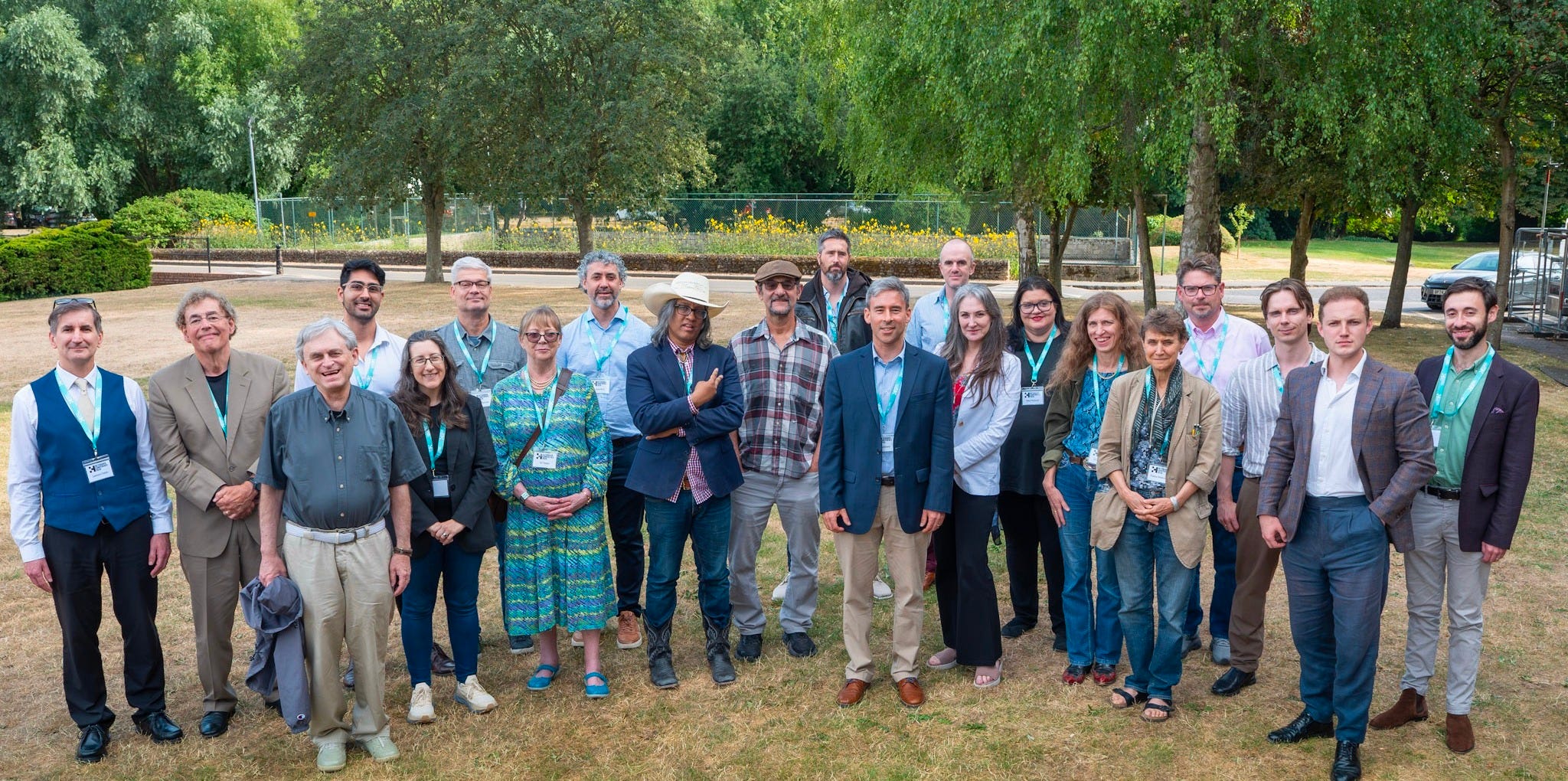
Last week I had the honor of speaking at the second annual Heterodox Social Science Conference at the University of Buckingham. I spoke about my dissertation research on gender dysphoria as a case study on the state of academic freedom.

The conference was organized by Eric Kaufmann, whom I met last year at ARC, and featured many courageous academics pushing back against the excesses of the ivory tower, including two of my favorite psychologists, Rich McNally and Pamela Paresky. (Two of my other favorite psychologists, Steven Pinker and Cory Clark, spoke at the inaugural conference but were not there this year.)
I was glad to be there and glad these “heterodox” opinions were being expressed. But I kept asking myself: Is this self-defeating branding?
If you listened to talks at the conference, or read articles published in its allied Journal of Controversial Ideas, you would find academics saying things like:
Cancel culture is bad. Academic freedom is good. Sex is binary.
These are mainstream opinions or even basic scientific facts. They are not controversial or heterodox anywhere outside of most ridiculous corners of the ivory tower. (Or the bridges that trolls live under in cyberspace.)
When we adopt labels like heterodox or contrarian, or frame perfectly reasonable (and often even boring) arguments as “controversial ideas,” we accept the academy’s premise that they are fringe, and we let the orthodoxy narrowly restrict the boundaries of respectable thought. I have some actually controversial ideas that I have never published, but perhaps I would if academic freedom was robust enough to platform a true “Journal of Controversial Ideas” that featured more than politically unfashionable opinions.
When I raised this, most people agreed there was something to it but it was mostly shrugged off. People liked being seen as heterodox or contrarian. Or, they felt so alienated by their colleagues, that it was a welcome respite to be in a group of likeminded thinkers.
The strongest reply I got was that heterodox, by definition, is the opposite of orthodoxy. Researchers should always strive to be heterodox, and it is a problem if any sort of orthodoxy comes to dominate the academy.
I have endeavored thus far to avoid the term “woke,” but it can’t be avoided. The fact is that Heterodox groups are not opposed to any vague orthodoxy but a very particular one that has been at the center of the culture wars. And, though the thinkers I most admire at this conference have heterodox beliefs in the true sense of the word, in many cases people who brand themselves “Heterodox” are simply anti-woke orthodoxy.
I’ve never liked the term “woke,” but it’s caught on enough that it is the most immediate way to highlight a particular set of beliefs and behaviors that animate the spirit of political tribalism and cancel culture. It’s still distasteful to me, but it rolls off the tongue better than what Jordan Peterson termed “postmodern neo-Marxism.”
But the word has grown on me, perhaps due to forced mere exposure, but especially once I and others realized that it is not a slur exclusive to left-wing progressives or postmodern neo-Marxists. Unfortunately, but not surprisingly—as this type of tribalism is part of human nature—we have been seeing a similar rise of tribalism and cancel culture on the “woke right.”
Some of the woke right was certainly present at this conference, just as it has come to infiltrate parts of movements intended to revitalize freedom, namely at the University of Austin and at New College of Florida. (I have interacted with both of these institutions and believe they are net-positive to improving our culture of academic freedom as a whole. But like any institutions, they have their problems.)
The most notable example was from speaker Christopher Rufo, who became famous for his war on Harvard when I was there as a graduate student. Most of his criticisms of academic orthodoxy were apt, and he played an instrumental role in ousting the plagiarist ex-president of the university, who should have been stripped of tenure outright. (She unfortunately remains a professor with a salary of over a million dollars per year, probably because their board concluded that lengthy lawsuits and more bad press would cost the university more than the $30-40 million this lifetime pension will cost.)
Though Rufo would disagree with this framing, I think he is one of the most effective DEI activists of our generation. If you read his Manhattan Institute Statement on Higher Education, or the letter of demands sent to Harvard by the Trump Administration, you will find many fair criticisms and good ideas. But there is an eerie similarity to the tactics and language of woke activists and anti-woke activists.
At the conference, people spoke of how institutional hegemony is stigmatizing and oppressing minority heterodox viewpoints. People with certain identities are being systematically discriminated against, and we need to reform hiring and admissions criteria. The culture lacks the right type of diversity and needs to be more inclusive and prioritize equality. Sound familiar?

The key concern is who gets to define “truth over ideology,” determine when a department has become political, decide which disruptions violate “civil discourse,” and enforce the “correct” balance of ideas. Give those powers to the federal government and their meaning will change with the administration. It sets a dangerous precedent.
As the Cato Institute argued in an amicus brief supporting Harvard, federal funding is not a right. But the government still may not condition a public benefit on the surrender of constitutional rights unrelated to the program being funded. The government has no constitutional authority to decide the proper mixture of opinions inside a private university, even if the existing mixture is genuinely skewed. It cannot require the recipient institution to rearrange its faculty, admissions, curriculum, and leadership until the president approves of its politics.
One of the defining features of wokeness is zero-sum tribalist thinking, us-versus-them narratives, and a tendency to enforce desired outcomes through institutional or legislative change.
The worst example of this came from a speaker who proposed banning transgender surgeries even in consenting adults.
This struck me as deeply illiberal hypocrisy, galvanized by the woke right’s momentum in the transgender wars. There is no objective distinction between breast augmentation or labiaplasty for a transgender adult or cisgender woman, though the latter’s body dysmorphia is usually not interpreted as gender dysphoria. They said the issue hinged on consent, that someone with gender dysphoria is experiencing mental illness and cannot consent to a potentially harmful and irreversible procedure. (I countered that the transgender people I’ve met—not activists or children, but otherwise ordinary adults attempting to live their lives as they choose—are among the most educated I’d ever encountered on hormonal and surgical treatment and often agonize over the costs and benefits, particularly the social costs.)
Their argument about gender dysphoria impairing consent could still be a reasonable argument, perhaps one for the Journal of Controversial Ideas, if it was internally consistent. But pray tell, where are the religious conservatives opposed to transgender surgeries, and female genital mutilation even on religious grounds, who apply that same logic to oppose circumcision? I was not persuaded that consent was the real principle.
Another defining feature of wokeness is internal inconsistency and strawmanning one’s opposition.
For example, for all of the Heterodox discussion about how affirmative action discriminates and undermines merit, no one seriously considered the strongest version of its argument:
What do we do when our measures of merit diverge from merit as such?
All else equal, would I be more impressed by the same test scores from a poor than rich student? The same h-index from someone coming out of a poorly-funded vs well-funded lab? The same number of publications from someone who did their PhD in 4 rather than 8 years?
In every case, my answer is yes. If they can produce the same with fewer resources, then they can probably outperform the better resourced person if given the opportunity.
What about cases where the observed merit is lower but the latent factor is probably higher? For example, a 1450 SAT from a poor public school kid is probably more impressive than a 1500 from a rich private school kid.
What about a male professor with no kids producing 10 papers in a year, compared to a female professor with three kids producing 7? Assume the papers are of similar quality. I might still be more impressed by the woman.
In both of these cases, the presumption is that there is an underlying latent factor that is actually more conducive to meritocracy than the blind numbers. Indeed, that is where the debates around the gender leaky pipeline often occur. Granting the slightly less productive woman tenure over the man, we might actually predict her to be more productive once the kids are out of the house.
How much is the optimal amount of affirmative action? The answer seems to me to be nonzero.
Some might say this type of affirmative action is a slippery slope to anti-meritocratic thinking, and however flawed our objective measures might be, we have to be consistent with them despite the appeal of these constructed edge cases, because the alternative will inevitably be worse.
That is a defensible argument, best articulated in Thomas Sowell’s book The Quest for Cosmic Justice. There are too many potential measures of advantage or disadvantage, and policy that seeks to rectify them will inevitably become weaponized; it is better to base policies on parsimonious and fair criteria while recognizing their limitations and the shared desire to select for that latent factor of merit.
But that is not what I heard. Instead, most of the discussion was shared grievances. A movement that defines itself by what it opposes turns into anti-woke wokeism. Heterodoxy had become an identity, and identity is a poor substitute for vision.
I say this all as a friendly critic who still belongs in the Heterodox movement more than not. I am glad it exists and want to see it held to high standards.
One of the things I love about working at Cato is that it has clearly articulated principles and a mission of what it stands for, not just what it stands against. Individual liberty, free markets, limited government, and peace.
If I were to create a set of principles for Heterodoxy, it would ironically be DEI. Diversity of viewpoint, equality of opportunity, and inclusion. The progressive principles as they were meant to be in their best formulations. Rather than framing the “woke” as an external enemy, we could recognize that the people we seemingly disagreed with had some admirable ideas, but poor implementation. And that the derogatory “wokeness” was to be found not just in the mote in their eye but in the beam in our own eye. That would be quite the olive branch.
I really enjoyed learning about your work at the conference!
I spoke to some of the other conference attendees about the peculiar mix of approaches at the Heterodox conference too - we were amused that it seemed to be an uneasy alliance between classical liberals and those who aim to get back to Enlightenment values/principles, paternalistic conservatives and some of the nativist / identitarian right (who don’t like term “ethnonationalists” in a way that reminds me of “woke” people not liking that label, at least in terms of the level of defensiveness). The only thing that unites all these viewpoints is that they’ve been firmly rejected by the “woke orthodoxy” that you describe and that can turn into a kind of grievance identity in and of itself.
On your specific criticism of the speaker who wouldn’t allow gender surgery for adults though, I am curious what you think of the comparison between gender affirming surgery and other analogous situations such as extreme body modification or treatment that involves cutting off healthy limbs as a remedy for able bodied people who identify as disabled or things like extreme cannibalism. I do think gender affirming surgery goes further than something like breast augmentation surgery so it’s more analogous to those other situations - in those realms, there has also been a fierce medical debate over whether doctors should cut off the healthy limbs or not (usually coming out in favour of not doing so). Given this, I’m not as certain as you are that the debate about adult surgery is only due to how the trans issue has played out. It’s also a very common complaint amongst adult women who identify as “childfree” that many doctors will not give them sterilisation surgery even if they desperately want it and are sure they will never change their minds. So, permanent infertility is already something that doctors feel very hesitant about even for consenting adults.
Even if we grant that it is exactly the same as cosmetic surgery though, it also worth noting that even in the realm of cosmetic surgery, the UK doesn’t actually allow many forms of “extreme” cosmetic surgery even if people say they consent to it - many people go abroad or to other less regulated countries for those kinds of treatments.
I wonder if there is a difference at all between the UK and America overall in terms of how it deals with these scenarios and how paternalistic it is?
“How much is the optimal amount of affirmative action? The answer seems to me to be nonzero.”
You should be focusing on merit but with the kind of gaps you’d expect from a poorer education. Maybe lower scores on the vocabulary section of the SAT and higher scores on areas that demonstrate comprehension.
Bottom line is that you are looking for untapped ability not actuated performance. IQ tests are designed for measuring such things.