


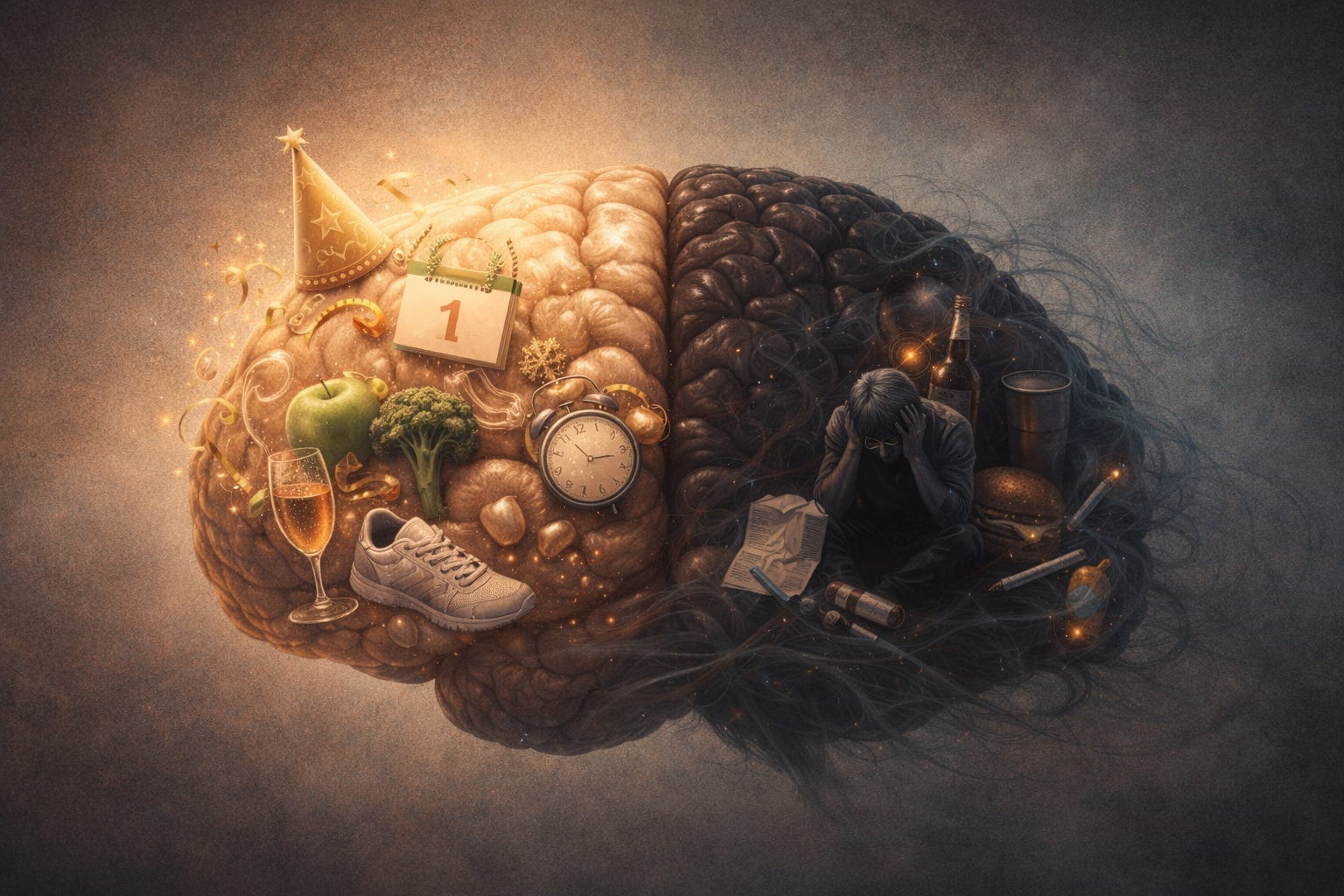
Like most people, I have successfully managed some New Year’s resolutions, and failed to live up to others. This is both entirely normal and entirely strange.
Think about it: the brain that makes the resolution is the very same brain that later procrastinates, rationalizes it away, or even feels shame and guilt at a level that is unpleasant—but not necessarily enough to do the thing. How can a mind be divided against itself?
It’s as if one part of the brain does the planning, while another part decides whether to carry it out.
That may sound like a convenient bioteleology for the over-promisers. But neuropsychology research shows that it is accurate.
The strongest evidence of this biological division between planning and executing comes from patients with a motor disorder known as apraxia (Greek for “without action”).
Apraxia is one of many doubly dissociable neurological disorders. This means that two aspects of brain function that are normally coupled may each be impaired, independently of the other, when different areas of the brain are damaged. For example, there are different types of language disorders, or aphasias, which impact language production versus comprehension. People with damage to Broca’s area within the language cortex will be able to comprehend language but struggle to produce fluid speech, while people with damage to Wernicke’s area will be able to speak fluently from a mechanical standpoint but struggle to comprehend or produce meaningful sentences.
Similarly, apraxia exhibits a double dissociation between ideational and ideomotor forms. As their names suggest, different types of brain damage uniquely impact action planning (ideation) and action execution (motor control). People with ideomotor apraxia typically have normal cognition and action planning ability, and are able to verbally describe each step in a complex sequence, such as cooking a meal or packing a suitcase, but are unable to execute the movements. When they try, their limbs will often stall, move in the wrong directions, or spontaneously begin performing an unrelated action. Conversely, people with ideational apraxia can complete individual actions fluidly but are unable to string them together into complex sequences. They may be able to perform a multi-step sequence, such as brewing tea, on command, but struggle to narrate the steps of grabbing a mug, opening a teabag, boiling water, and pouring water if asked in the abstract.
Case studies of brain damage patients prove in the abstract that action planning and execution rely on separate dissociable systems, but do not explain why most people with healthy, intact brains often renege on their plans. A different, algorithmic level of analysis is necessary to understand the neuropsychology of New Year’s resolutions.
My high school calculus teacher was a joyful old man who actively followed the evolution of computer programming throughout his lifespan, from floppy disks and BASIC to modern object-oriented programming and portable laptops orders of magnitude more powerful than the supercomputers used in the Apollo missions. He remained fond of TI-84 graphing calculators, anachronistic by my time but a marvel in his, and taught us not only to graph but to write programs within the calculator. It was every bit as painful as it sounds, akin to texting one letter at a time on old flip phones, but we were able to make remarkable simple programs. For example, calculating the orbital velocity and length of the year for any planet of a given inputted distance for a sun of a given mass.
Sometimes our code would generate errors, and my teacher would tauntingly remark, “The machine is smart. It does exactly what you tell it to do. If you’re getting the wrong output, you gave it the wrong instructions.”
Could our brains work the same way? Could it be that for a given output, there is an optimal set of instructions, and we could always reliably achieve our goals if only we were smart enough to program ourselves properly?
This perspective aligns with the computational theory of mind, popularized by my graduate advisor Steven Pinker in his book How the Mind Works (1997).
The computational theory of mind has arguably become the default framework for understanding how the brain works and inspired early research into artificial intelligence. Neurons function remarkably like binary transistors: they fire or do not, and can perform logical operations when strung together into groups known as neural networks. (Though the earliest artificial neural networks were directly modeled after biological neural networks, they have since evolved into their own exotic form of intelligence.)
The computational theory of mind also helps make sense of aphasias and apraxias. If the brain is an elaborate computer relaying information, damage to parts of the brain disrupts that signal. It also explains why brain signaling can be reliably interrupted with electrodes, transcranial magnetic stimulation, or psychoactive drugs. Like electromagnetic signal jammers, these external influences can all disrupt the brain’s natural bioelectric and chemical signaling. It also explains why Elon Musk’s Neuralink has achieved remarkable success decoding brain activity via implanted electrodes that allow patients to control computers with their minds.
But again, how does any of this explain why healthy brains don’t reliably stick to the plans made by the very same brain?
The 17th-century philosopher René Descartes is most famous for his phrase cogito ergo sum—“I think, therefore I am.” Descartes was a proponent of mind-body dualism, reasoning that his mind must be distinct from his body, since he could doubt the existence of the latter but not the former. Knowing that it was possible to hallucinate and be deceived about one’s environment and even one’s identity, Descartes took his thought experiment to the extreme: Even if he was living an elaborate dream or false reality constructed by an evil trickster demon (what we now might term living in The Matrix), he could at least be sure that he was conscious in some form. For a conscious being, this is the only unshakable self-evident truth.

Neuroscientist Antonio Damasio, centuries later, rebuked mind-body dualism in his landmark Descartes’ Error (1994). This book was strongly influential on my decision to pursue psychology and neuroscience research. Damasio, reviewing the centuries of progress in neuroscience since the time of Descartes, compellingly demonstrates that dualism is untenable and that we are identical to, and causally influenced by, our brains. But Damasio does concede one form of dualism fundamental to understanding mind and behavior.
Back to double dissociation. In case studies of patients with ventromedial prefrontal cortex (vmPFC) damage—the part of the brain most evolved in humans, and relevant for complex thought, planning for the future, and decision-making—he finds surprisingly little deficit in cognitive functioning. These individuals retain intelligence, memory, and explicit reasoning. They can outline plans, compare options, and articulate consequences with impressive clarity. What they cannot do is act. Faced with mundane decisions, they ruminate endlessly, cycling through possibilities, unable to make a choice.
It turns out that in many of these patients, following a stroke, the damage that occurred to their brain happened not to the cortex itself but the white matter tracts connecting the cortex to the limbic system—the brain’s emotional hub. When parts of the vmPFC are obliterated, such as in gunshot survivors, or most famously, in the case of Phineas Gage—a 19th-century railroad worker who survived an iron rod being shot through his skull in an accidental mine explosion—people lose this cortical planning ability. Their personality changes, they become impulsive, emotionally erratic, and their limbic system controls decision making without cortical inhibition. But conversely, when the vmPFC remains functional but unconnected to the limbic system, people are stuck rationalizing and ruminating endlessly, all brakes no gas.
Damasio’s key insight was that emotion is not just sufficient but necessary for decision-making. This makes sense from an evolutionary perspective. Most animals act directly from instinct. The brain’s limbic system evolved hundreds of millions of years ago and is functionally conserved across vertebrates. Our prefrontal cortex evolved from a more primitive motor cortex, and as action planning becomes more sophisticated and extends over longer timespans, we must develop the ability to regulate our emotions and inhibit impulsive actions. But without excitatory signaling, mediated by rewarding chemicals such as dopamine or threat signals generated in the limbic system, we lack motivation to act at all.
Damasio’s “somatic marker” hypothesis, referring to the fact that all decisions must be grounded in an emotion or bodily state known as somatic markers, integrates seamlessly with the computational theory of mind. Though in reality there are innumerable distinct networks in the brain arranged in dazzlingly complex ways—with over 86 billion neurons and over 100 trillion unique connections in the average human brain—it is a useful heuristic to think of simply two competing systems active at any given time for any given decision: activation or inhibition. This loosely maps onto the two systems described by Nobel laureate Daniel Kahneman in his landmark Thinking Fast and Slow (2011). Most of our thoughts and decisions are made by an intuitive, efficient, “fast” emotional system. But we also possess a second deliberate, computationally costly, rational “slow” system.
This is the system that (we hope) makes our New Year’s resolutions. But at any given time, our brain has strong incentives to let our fast emotional system take over, saving energy and cognitive resources. So, is that it? To keep our resolutions we need to remain mindful of the reasons we made them in the first place, and consciously exercise control over our daily emotional whims, knowing that there will be constant pressure to slip? The Stoics could have told us that, thousands of years ago, without needing to know any neuroscience.
Neuroscience gives us pragmatic psychological insight, and validates timeless wisdom, most when framing things computationally. Karl Friston, the world’s most influential neuroscientist (as measured by citation count), frames the brain as a lazy “prediction machine” which aims to reduce entropy. As my calculus teacher once said, our computers are only as useful as the instructions we give them. A vague New Year’s resolution, like “be healthier,” is almost destined to fail. It has too many degrees of freedom, and is too easy to exploit. The emotional system can even co-opt the reasoning system to rationalize its whims. (Well, the jelly donut has fruit in it, and fruit is healthy…)
As cognitive psychologists and Stoics alike will affirm, the more concrete and low-hanging a goal is, the more likely we are to successfully manage it. And as the best behaviorists know, any large goal can be broken down into smaller sub-goals. This has not just the benefit of outlining clearer instructions to success, but it reduces entropy, and makes it more computationally costly to rationalize than to simply do the thing.
Of course, many believe the concept of New Year’s resolutions is silly, that we should be constantly working towards our best selves using whatever tools we can glean from cognitive psychology, neuroscience, or ancient philosophy. Why wait until an arbitrary day of the year, and risk being part of a bandwagon that it is almost normalized to abandon?
I for one find it a tremendously useful exercise, because of some of the principles of computational neuroscience outlined here. We are nearly constantly minds divided against ourselves, but we are nothing but our brains and the information that is fed to them. Because behavior is so fundamentally governed by emotion, it helps to align as many axes of motivation as possible, including social pressure. The more opportunities we can take to remind ourselves of the gap between our actions and our ideals, and the more concrete we can make the steps towards minimizing that gap, the better.
Remember, your brain is smart. It does exactly what you tell it to do. If you’re getting the wrong output, you gave it the wrong instructions.
We are intelligently imperfect animals, homo emotionalis sapiens stupidus.
Happy New Year, Adam!