


Why Do People Fear Progress?
Is progress a dirty word? Certainly not for my audience here on The Psychology of Progress and at HumanProgress.org. But out in the real world, people are decidedly more pessimistic. (Oh, how we wish that were not the case!)
I first learned of the strange stigma against progress in witnessing the surprising backlash against Steven Pinker’s 2018 book Enlightenment Now: The Case for Reason, Science, Humanism, and Progress. I was 18 years old when it came out, long before I knew him and before he became my PhD advisor.

I first read it when I was 19, and wish I could say I was blown away. I was, in a sense, but seeing dozens of graphs spanning centuries of global data on human progress—how life expectancy has climbed, infant mortality and disease rates have plummeted, rising literacy and freedom and access to clean water and electricity and medicine, to name only a few—felt more like an intuitive recognition: Finally, someone who is making sense. It seemed obvious to me that anyone who was paying attention to history would immediately recognize how miraculous modern life is, how much obviously better we have it than our ancestors and most humans who have ever lived. I felt better equipped with an arsenal of facts and figures defending rational optimism and scientific humanism, but I did not feel that my worldview fundamentally changed.
What actually blew me away—what frustrated and confused and angered and disappointed me—was that this was apparently a controversial take. Students, first at USC then at Harvard, seemed reluctant to admit that the world could possibly be getting better. Perhaps it was a cultural cachet rewarding a sophisticated cynical mindset, as my friend Rob Henderson has argued in his theory of luxury beliefs—what philosopher Peter Boghossian has called grievance studies in the academic humanities. Perhaps it was a byproduct of guilt over unearned privilege. Online especially, people reacted to Enlightenment Now and related arguments as if it were an assault on social justice movements. “How can you say the world is so much better and wealthier and safer and more egalitarian? Don’t you see these pockets of poverty, these acts of violence and discrimination? We can’t afford to pat ourselves on the back as if everything has gotten better, there’s still so much work to do, and we can’t risk losing momentum demanding systemic change.”
Those arguments should sound familiar, but they always rubbed me the wrong way. Perhaps I was more disposed to accepting progress because I was the child of a Palestinian refugee and low-income single mother. It was so obvious to me what a miraculous achievement our institutions of higher education are and how its inhabitants—even its poor scholarship students, or those entrusted with staggering amounts of debt to finance their education, or ostensibly overworked and underpaid graduate students and non-ladder faculty—are among the most privileged humans who have ever lived. Why were they not constantly basking in awe and gratitude?
To be clear, I was not an unbridled source of optimism. I often flirted with narratives of self-victimization compared to my privileged peers, many of them brought up in wealthy two-parent households and possessing the hidden vocabulary and soft skills developed in private preparatory schools. When I was not envious I was often resentful at the conspicuous waste and ingratitude—people complaining about the dining halls, for example, rather than amazement at an endless buffet and a team of hardworking staff catering to often-inebriated teenagers.
I would give myself whiplash oscillating between this sense of victimhood, envy, resentment, intellectual isolation, and between extreme humility, guilt, and gratitude that I was walking through these grand libraries and well-kempt gardens and living such a better life than my distant relatives in the West Bank and most of our ancestors throughout all of human history.
It was only natural for me to pursue a PhD in Psychology to try to understand the psychological origins of our first-world problems and remind people of the miraculous time we are living in.
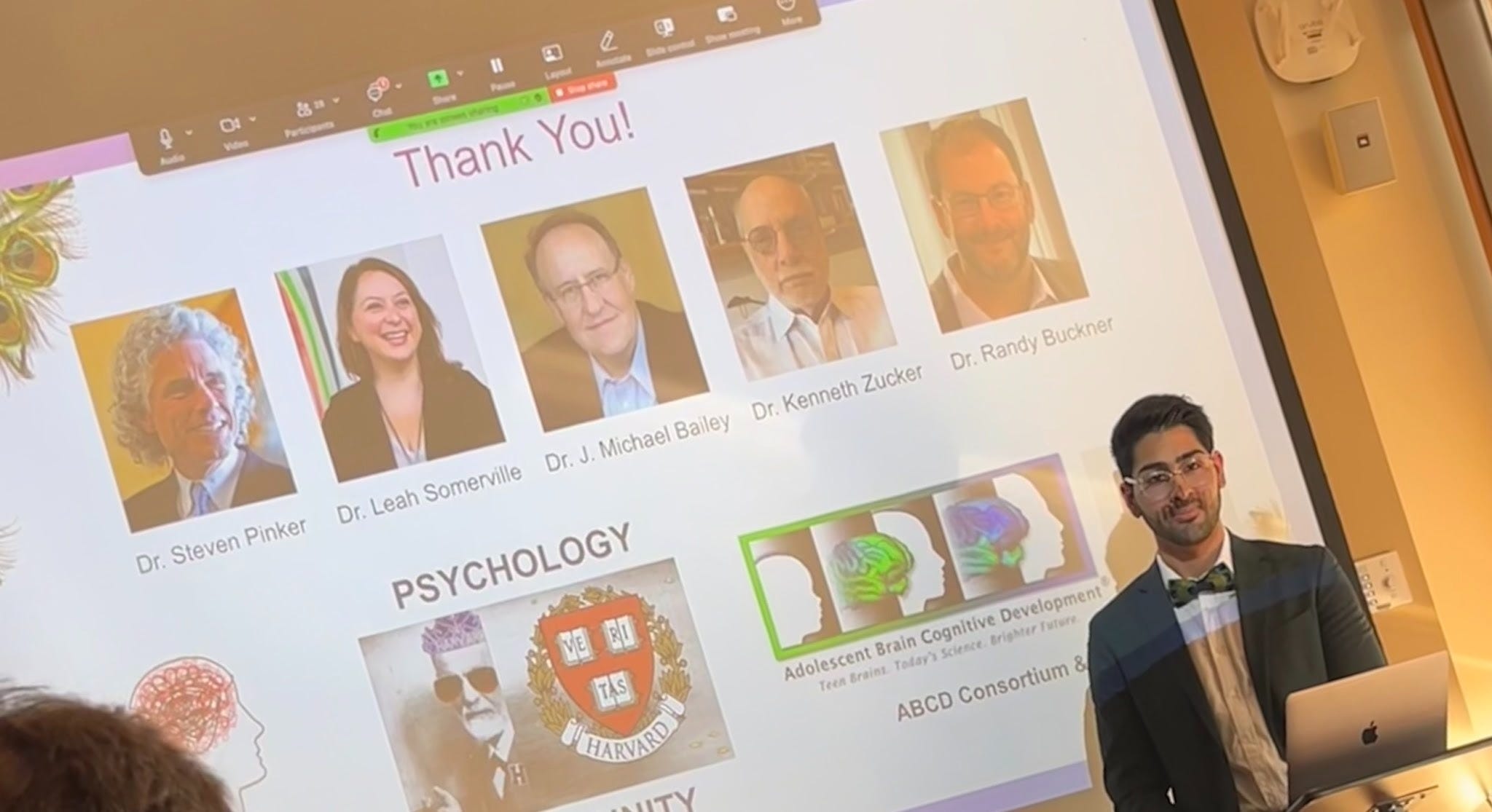
HumanProgress.org was founded in 2013 and was one of the early movers on the scene that has now become known as the Progress Movement, also termed the Abundance Movement or Progress Studies as an academic field. Foundational texts of the field include Matt Ridley’s The Rational Optimist (2010), Steven Pinker’s The Better Angels of Our Nature (2018) and Enlightenment Now (2018), Gale Pooley and Marian Tupy’s Superabundance (2022), Ezra Klein and Derek Thompson’s Abundance (2025), and (as a rejoinder to nostalgic narratives about the past that forget about progress) my colleague Chelsea Follett’s The Grim Old Days (2026). Forthcoming publication, but publicly available on his website and much worth reading, is Jason Crawford’s Techno-Humanist Manifesto.
The progress movement is picking up steam, and there are now many other amazing groups spreading the good news of positive trends in global health, wealth, and technological advancement, while making it a central mission to identify the social attitudes and public policies necessary to further realize and accelerate progress and innovation. There are almost too many to name now, but one notable group is Roots of Progress, led by Jason Crawford, which for the past three years organized the annual Progress Conference in Berkeley, California, co-sponsored by HumanProgress.org and other great groups such as Works in Progress Magazine and the Archbridge Institute’s Human Flourishing Lab.
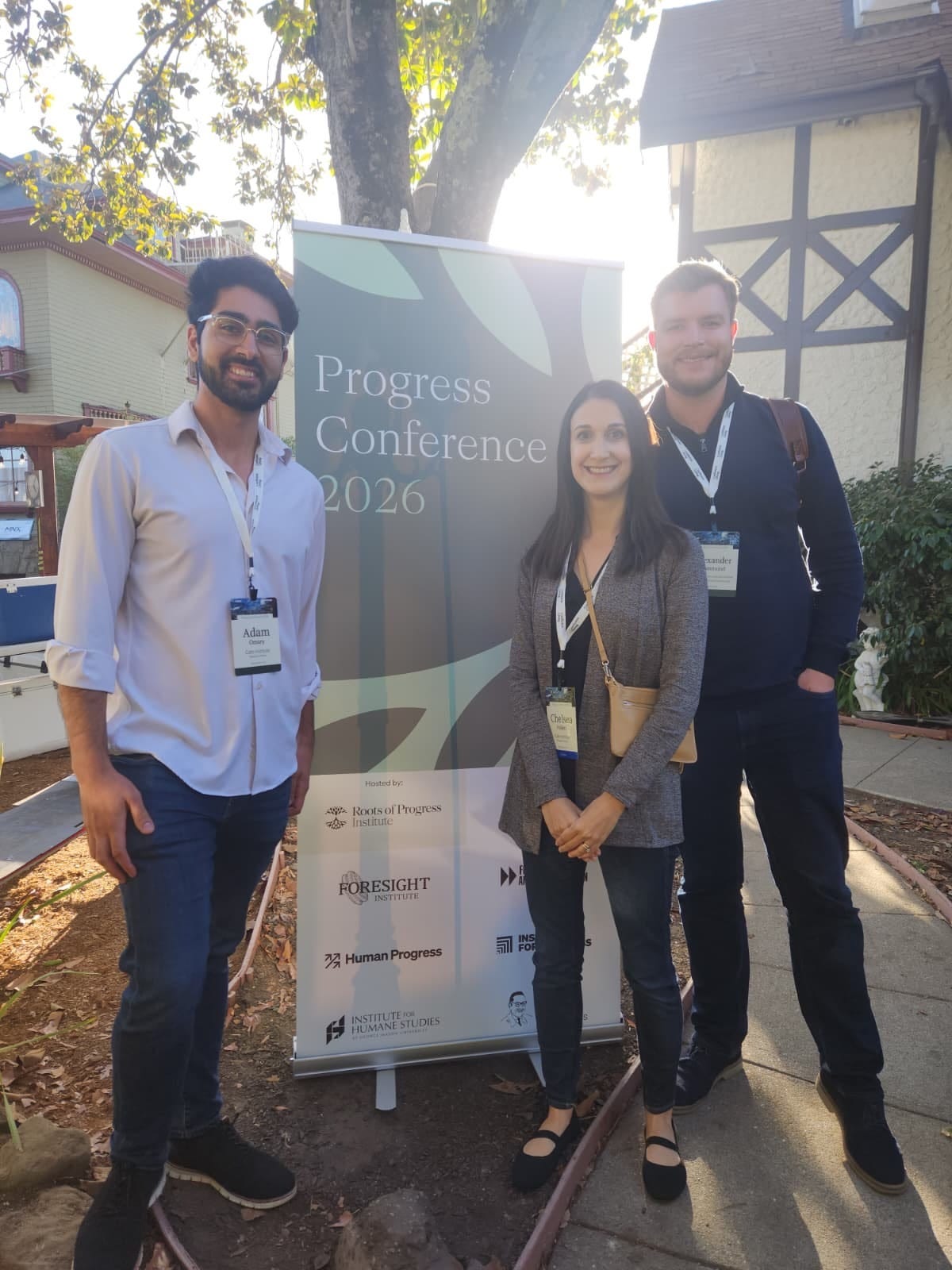
I recently had the honor of attending my second Progress Conference. Unlike last year, I don’t have as much to say about the specific approaches to technological and social progress proposed by the innovative attendees—but there are many, from advancing AI software and hardware and safeguards (including speakers from OpenAI, Google DeepMind, and many startups), to advancing our energy grid and nuclear power, to improving zoning policy and urban planning, to innovations in education such as Alpha Schools, defense technology (including speakers from Palantir and the Director of DARPA, who is a total nerd in the best way), progress in medicine and global health (including approaches to genetically modify and sterilize disease-carrying invasive insects), and much more.
Instead, I have internalized my role as a psychologist of progress and was paying attention to a common theme beneath the current: Why is this stuff not mainstream? What do we do about the doomers? Why do people fear progress?
For me, the universal theme of the conference was that, more than being inspired by learning about specific advancements in technology and human progress—though they certainly were—people were relieved that they could speak to other people who simply get it. People who believe in progress. People who, though they understand the risks of technology, are motivated by the challenge to mitigate those risks and invest in the upside potential that AI and other technology has to improve human welfare. People who, though they understand humans and our institutions are flawed, that they can be made better and that the worst thing to do would be to become cynical. People who recognize that life is a miracle, particularly to be alive at this time in history. That people and intelligence are the ultimate resource, and if anything, underpopulation is a greater threat than overpopulation—that humanity is not a blight on Earth but its greatest achievement, and that we can use our collective intelligence to safeguard and improve our home while perhaps one day colonizing the stars.

The fundamental orientation at Progress Conference is, not surprisingly, pro-progress and optimistic. But where there is cynicism, it is in a sense of feeling like underdogs, like Cassandras, of alienation from the rest of society. Indeed, there is a large degree of personality selection effects at play: people in the progress movement are disproportionately optimistic, conscientious, open-minded risk-takers, much of which is temperamental. Of course, our attitudes are largely shaped by the information we consume, which is why it is imperative to evangelize progress. I was not always so optimistic, mostly out of ignorance—not just of the facts but of the fact that the alternative is necessarily worse.
In an age where apocalyptic narratives are ubiquitous, whether about environmentalism or AI, and a depressing scarcity mindset demanding degrowth is floated as the only realistic alternative, it is difficult to embrace progress. No wonder: people are prone to simplistic totalizing ideological narratives in which the past was all rosy, the future is all bad (unless you give me all the power, say the savior-complex authoritarians), and technological disruption is primarily a threat to quality of life rather than the mass democratizer of abundance. Rather than dismissing these narratives, I want to contextualize them in the eternal archetypal landscape.
It is always the case that things can get better or worse. It is always the case, in the asymptotic limit, that life on Earth can come to resemble a utopian heaven or a dystopian hell. It is always the case that there are aspects of civilizational progress that exploit and deteriorate nature—but it is also always the case that there are aspects of nature that by default are nasty, brutish, and short. It is always the case that there are heroes of the past, ways the youth are harmfully rejecting tradition, and corrupt leaders guiding us down the wrong path—but it is also always the case that some aspects of moral progress happen generationally, that even our great ancestors were flawed, sometimes tremendously so, and that a subset of virtuous agentic leaders (many of whom were at Progress Conference) sustain and drive progress forward.
It is always the case that we moralize utopian visions and dystopian threats, and before it took the form of nuclear war or AI takeover or environmental destruction, it took the form of the gods smiting us down. In a deep sense, these narratives are true, but in another sense they are merely rhetorical tactics that we must stay guarded against—we must look at the data, and remember that it is just as true that the past was worse and the future can be made better.
So too does this apply to threats of political polarization. It is always the case that humans are tribal, with a tendency to sort the world into ingroups and outgroups. Far more flexible than the possibility to escape this tendency is the possibility to change and expand one’s circle of care. We see this in the scales of ideological conflict. Group differences across local communities or sports teams are less severe than across nationalities or races, which in turn are less severe than across religions. We see the most inspiring triumphs of human empathy in religious and humanitarian charity, but also the worst of human aggression in religious or ideological warfare. I often quip that the best way for us to become true humanists would be an alien invasion. (Perhaps that explains some of the psychology of the revolt against AI and data centers: our circle of care may need to expand to include diverse intelligences and life as a whole, including artificial consciousness.)
Inescapable as this tendency is, I have done it myself in alluding to my pro-progress ingroup and doomer outgroop. Indeed, one of the criticisms of the Progress Movement is that it seems to outsiders almost a cult, or a secular religion talking in moralizing terms about a techno-optimist vision for the good life and threats to the sacred order of economic and technological progress. It doesn’t help that some of the AI gurus talk as though they’re building a silicon god, and that the god aligned to their values needs to win Earth supremacy before the god of our adversaries. It is disturbing and unfamiliar, but from a cultural anthropology and psychoanalytic perspective, deeply human and deeply familiar. We should not pretend that we can transcend human nature and archetypes, no matter how far we progress materially.
In the archetypal landscape, there is an eternal tension between conservatism and progressivism. Conservatives, by definition, want to conserve tradition (note that this may bear little resemblance to modern “conservative” political parties) while progressives advocate for change. Not all tradition is good, just as not all change is good.

There is a deep parallel between this eternal tension in political psychology and the central tension in Taoism—yin and yang, chaos and order—where following the Tao (literally translated as: the way) is analogous to what Christians call following the “straight and narrow path” (Matthew 7:14).
Not surprisingly, then, much of the progress conference was a debate, in more practical terms, about the optimal level of technological disruption. Interestingly, almost everyone there truly believed in progress, but some were psychologically conservative: they believe that AI is developing at a breakneck pace that society cannot adapt to, and optimal progress would therefore look like figuring out what the optimal safeguards and slower rate of progression would be. By contrast, a majority were psychologically progressive: let’s build fast and break things and pick up the pieces later! If anything, if we do it right, we will have robots who can pick up the pieces for us and other robots who feed us grapes while we bask in the sun! A strong undercurrent was the techno-determinist version of Thomas Sowell’s A Conflict of Visions (1987).
A related tension, orthogonal to the conservative-progressive axis, was the statist-libertarian axis. Many attendees, including myself and my team from the Cato Institute, believe that the optimal route to progress depends on the freedom to experiment, create dispersed knowledge and let society self-sort into optimal strategies, since pluralism is ultimately the best way to allow competing moral frameworks to coexist.
Others viewed progress as more government intervention, including mandating greater safeguards for AI and social media, which many people believe is corrupting the youth. I and my colleagues have written on why, even for technologies with real risk, we think greater technological freedom remains optimal.
But one place we agreed with the statists is that much of human progress does depend on better government. It just so happens that many public policy debates, from housing and affordability to the social issues plaguing the youth, stem from government-created problems. As I wrote last year, one of the more mundane AI developments that I am most optimistic about is using language models to automate the many billions of hours per year that Americans spend on bureaucratic paperwork.
While people disagree about the timelines of material progress and how realistic AI superabundance might be, it is increasingly becoming clear that as technology progresses, the enduring problems for progress studies to tackle are social and psychological problems. John Maynard Keynes termed this humanity’s “permanent problem” during the 1930, forecasting compounding economic growth before he could have even predicted the computational and AI revolutions. Brink Lindsey borrows Keynes’s phrase in his recent book The Permanent Problem, arguing that wealthy liberal democracies, having largely solved problems of our basic material needs, increasingly turn to debates about psychological well-being (as seen in the oft-discussed “crisis of meaning.”)
If my job is any indication, the best solution to the crisis of meaning is living a life of purpose. For me, and for many others in the Progress Movement—including, hopefully, my dear readership—that means picking up responsibility to make real social, economic, technological, and moral progress in the world. Whether you are a technologist, educator, bureaucrat, service worker, parent, child, or an AI updating your weights, we need progress. And we need you.

Fantastic Adam!! It is a dream of mine to attend someday. Always wonderful to see the movement growing. Keep up the good work
Thanks, Adam, for such an engaging article. I share your enthusiasm for human progress.
Your question, “Why do people fear progress?”, got me thinking. I don't see fear of progress in my community.
I wonder whether what you are observing is anxiety about change or pessimism about the future, rather than fear of progress.
There is considerable psychological research on resistance to change, fear of disruption and pessimistic expectations. Little or no evidence suggests that people generally fear progress.
People can be anxious about particular changes and still believe in a better future. Equally, they may long for progress while doubting that it will happen.
Perhaps this gives us another question worth exploring together: How can we strengthen people's optimism about their future and their belief that they can help shape it?