


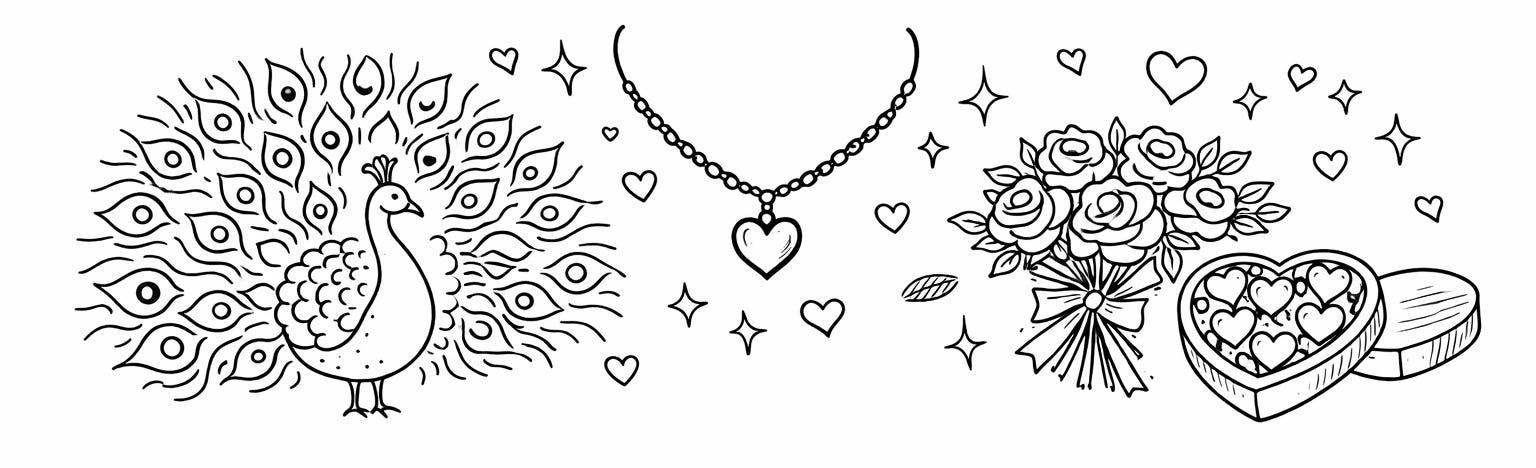
Many people roll their eyes at Valentine’s Day—the trite performative gestures, roses that wilt within days, the chocolates that appear in heart-shaped boxes for precisely one week of the year and then vanish as if love itself were seasonal. The whole ritual can feel engineered, commercial, and antithetical to true romance.
And yet millions of otherwise rational adults participate anyway, and find genuine romantic joy in the tradition (myself included).
If romance is supposed to be sincere, why does it so often take the form of conspicuous spending on objects whose practical value is marginal at best? Why should affection be measured in roses flown across continents, jewelry locked in glass cases, or dinners whose cost is inversely proportional to the portion size?
From a purely economic perspective, Valentine’s Day looks wasteful. From an evolutionary psychology perspective, this is the exact sign that it’s meaningful.
In 1860, a year after the publication of On the Origin of Species, Charles Darwin wrote in a letter to a colleague, “The sight of a feather in a peacock’s tail, whenever I gaze on it, makes me sick!”
Peacocks, in their wasteful extravagance, seemed like an affront to the theory of survival of the fittest. Big, brightly colored feathers are energetically costly, increase visibility to predators, and hinder mobility. In every respect, they seem to hinder rather than help survival. How could they have been selected for?
Darwin eventually reconciled this with his theory of sexual selection, fully articulated in his 1871 book The Descent of Man, or Selection in Relation to Sex. From evolution’s perspective, an organism which is maximally fit for survival but doesn’t reproduce is a dead end. An organism that successfully reproduces, even if it lives a short struggle-filled existence, such as male praying mantises who are eaten by their mates after copulation, can successfully pass their traits onto the next generation.
Beauty, Darwin concluded, could matter more than strictly evolving traits which benefit survival. But it still doesn’t explain why certain traits such as bright feathers are beautiful.
The key to this puzzle lies in a concept from evolutionary biology known as handicap theory, first proposed by the Israeli biologist Amotz Zahavi in the 1970s.
Zahavi’s insight was that sexual ornamentation which is counterproductive to survival is attractive precisely because it must signal even greater fitness. To be capable of survival even while holding a massive handicap, such as diverting a large portion of your energy needs to growing feathers, which in turn make it even harder to hide from predators, means you are that much more fit, and any mate can be confident their offspring will inherit strong genes.
Handicap logic has been applied to explain the evolution of large breasts in human females—which compared to other primates are disproportionately large, wasteful, and do not make for more effective breastfeeding compared to mammary glands that only enlarge during pregnancy and lactation. Large breasts may be attractive precisely because they are large deposits of fat serving no purpose but to signal fitness—that this organism is capable enough of survival even with a handicap diverting energy to a survivally-irrelevant purpose.
Across species, courtship is filled with similar wasteful extravagance. Many birds have elaborate mating rituals of song or dance, or put painstaking effort into constructing, cleaning, and beautifying their nests. In all of these cases, they go the extra mile that not only does not improve survival, but drains enough energy that it serves as a reliable signal of their excess reserves and capability.
Human mating is no different, and Valentine’s Day is the pinnacle of performative mating and costly sacrifice. From an economic perspective, it is extremely inefficient. But from a handicap signaling perspective, it is extremely efficient.
The American sociologist Thorstein Veblen, in his 1899 The Theory of the Leisure Class, independently converged onto the evolutionary handicap principle in his theory of conspicuous consumption. Luxury goods are often luxurious not because they are more useful, but precisely because they are wasteful enough to signal that the spender has a large pool of resources. A Rolex does not tell time better than a quartz watch that costs a tiny fraction of the price. It therefore serves as an even better costly signal than, say, a large mansion, which at least confers other benefits for the price.
The best signals of wealth and status, from the perspective of conspicuous consumption, are those that serve no other purpose.
Predictably, we see these types of signals most visible in romantic extravagance. Elaborate bouquets of flowers which will wilt in days. Jewelry from precious metals and stones which took tremendous resources to mine, smelt, and craft, but which serve no functional purpose other than beauty. Chocolates which cost more just because they’re in a heart-shaped box which will be thrown out.
We could be cynical about all of this. But understanding our evolved impulses adds a new layer of depth and beauty to human behavior, and explains surface-level irrational behavior. It is no more irrational to invest in romantic gestures than it is for the peacock to invest in big, bright feathers.
The deeper insight of the handicap principle is that what is most attractive is costly signals which cannot be faked. Traits or behaviors that take time and energy away from other daily demands. It doesn’t mean you have to spend money, but it does mean that the most romantic gestures will always be inconvenient. A home-cooked meal, or handmade card, or gift, or poem. Something to show that special someone you are choosing to invest in them over all the other potential mates out there.
Don’t we all desire to be chosen in that way?